
Licences without a metric
ChatGPT, Copilot and Cursor are paid for, but nobody can say how many hours they remove. Without a metric, the investment cannot be defended in the P&L.
ERP consulting since 2000 · DACH and Southeast Asia
We have spent 25 years improving ERP processes in mid-sized companies. Today we train your departments to build their own tools with AI – while covering the training obligation under Article 4 of the EU AI Act.
† Observed across client projects. Actual relief depends on process and data quality and is measured during the Opportunity Scan.
We arrive at companies that have been experimenting for a while. What is missing is rarely another tool – it is ownership, evidence and a process that produces a number.
ChatGPT, Copilot and Cursor are paid for, but nobody can say how many hours they remove. Without a metric, the investment cannot be defended in the P&L.
Since 2 February 2025, Article 4 of the EU AI Act requires commercial users to ensure AI literacy in their workforce – depending on role and use case, and in a verifiable way.
Classic software projects run 9 to 18 months. Nobody has capacity for an internal helper tool, while departments lose hours to copy-and-paste every day.
Each program can be booked on its own. Most engagements start with the scan, because it establishes which two processes pay off first.
Two weeks with the leadership team: up to five core processes are reviewed, the three most rewarding interventions prioritised, and licence cost compared against on-premise. The output is a decision paper for the board, advisory council or bank – not a presentation full of potential.
Four weeks, one to two sessions per week. Specialists from purchasing, sales, work preparation or customer service build two or three real tools on their own data and learn to connect knowledge bases (RAG). No programming background required. Every participant receives a capability certificate at the end.
Role-based training for the workforce, a usage policy, prompt rules and an AI system register modelled on the record of processing activities. The documentation is written so that auditors and supervisory authorities can read it.
When data must not leave the building: open-weight models (Qwen, DeepSeek, Mistral, Gemma) served through vLLM or Ollama on your own hardware, knowledge base in Qdrant or pgvector. ERP access is read-only through staging layers – no tool writes directly into production tables.
Both come from client projects and were built by specialists in work preparation and customer service. Both run publicly as demos – you can click them there.
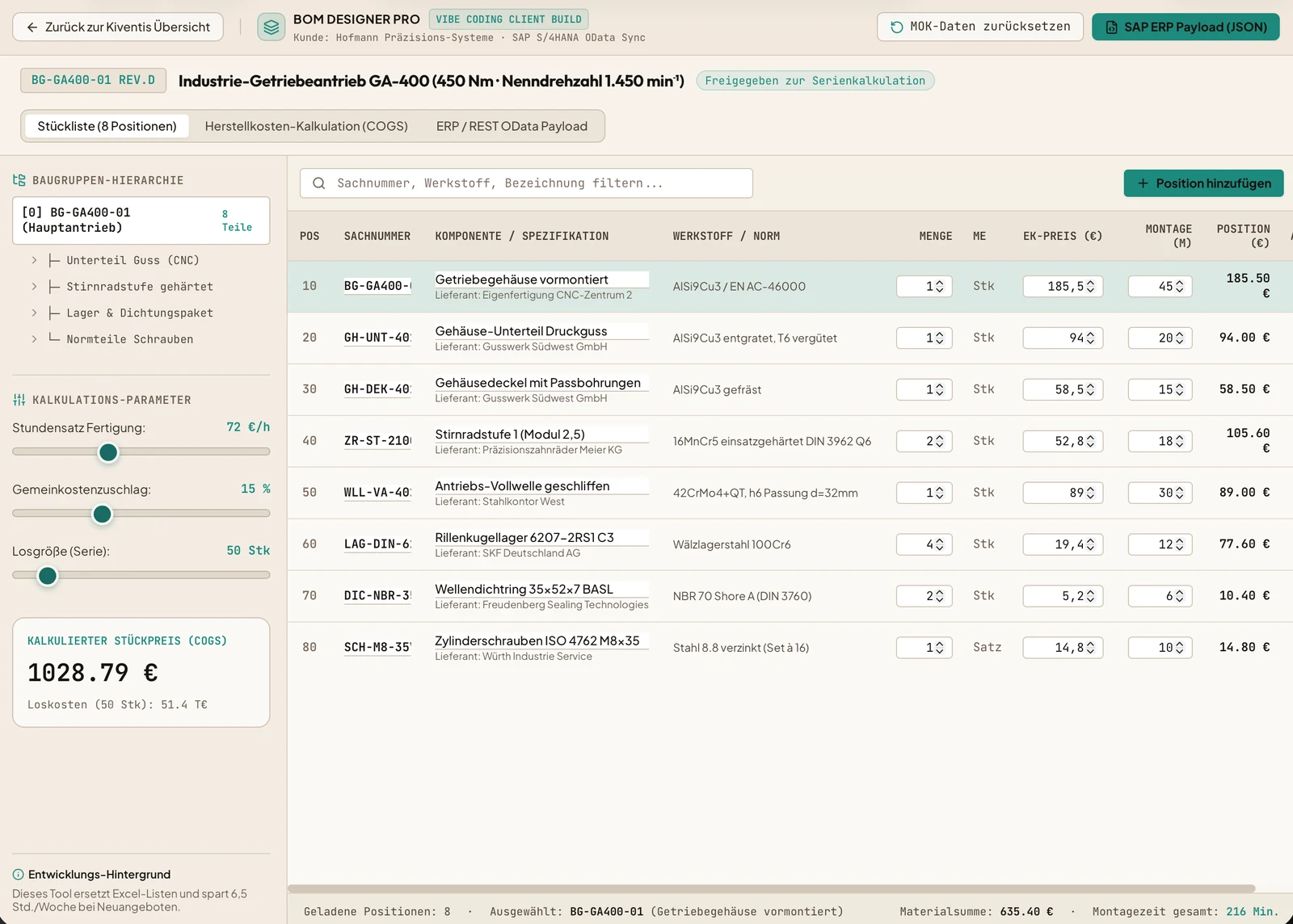
Bill-of-materials and configurator calculator for manufacturing and mechanical engineering, with ERP export. Work preparation assembles configurations without writing a line of code.
Open live demo →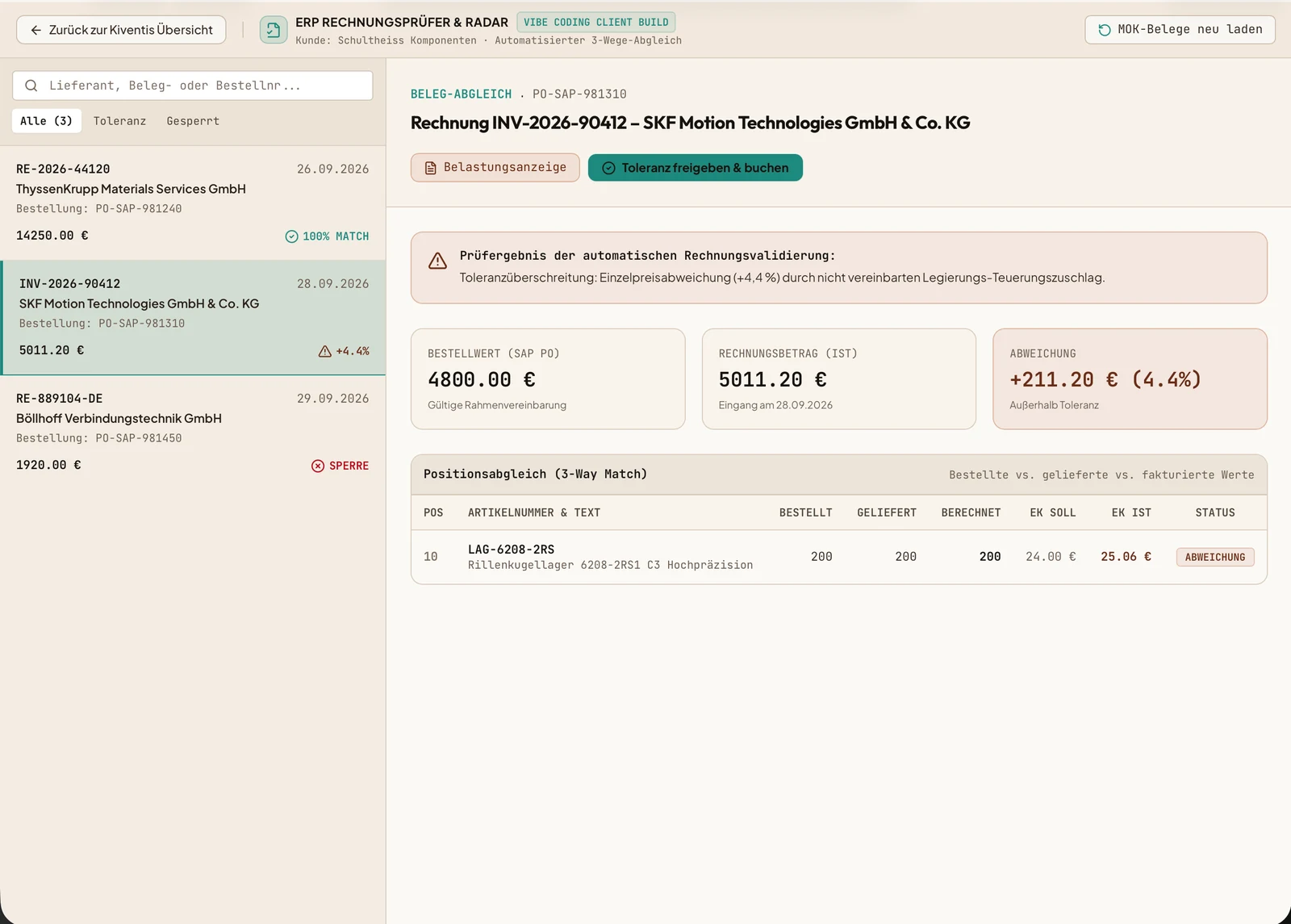
Three-way matching of incoming invoices against purchase order and delivery note, with tolerance checks and an approval workflow. What used to take 15 minutes per case now runs in under three.
Open live demo →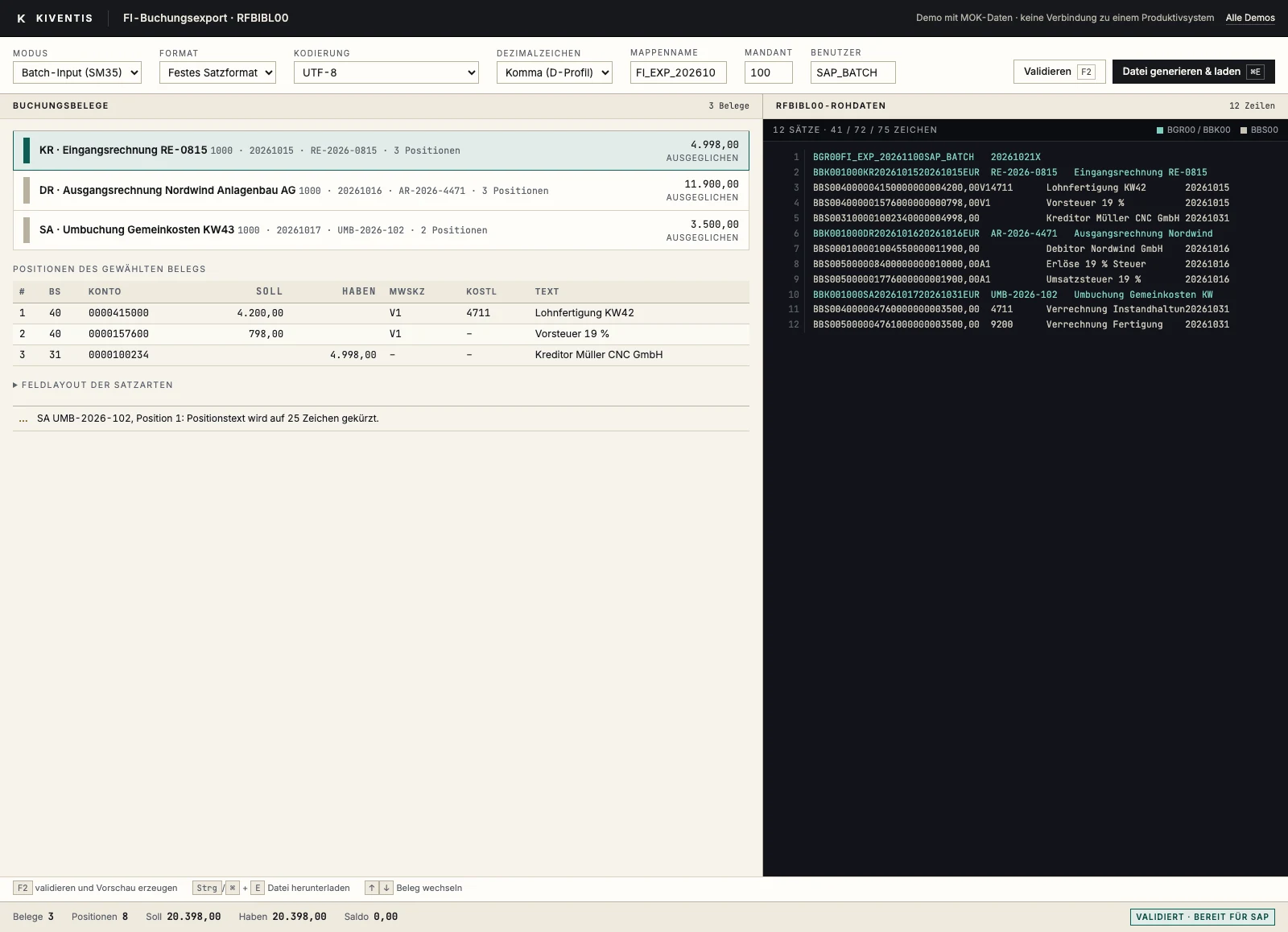
Accounting collects its documents in one list and uploads them as a finished RFBIBL00 file instead of entering every posting in the SAP layout. Before export, the tool checks that debits and credits balance per document.
Open live demo →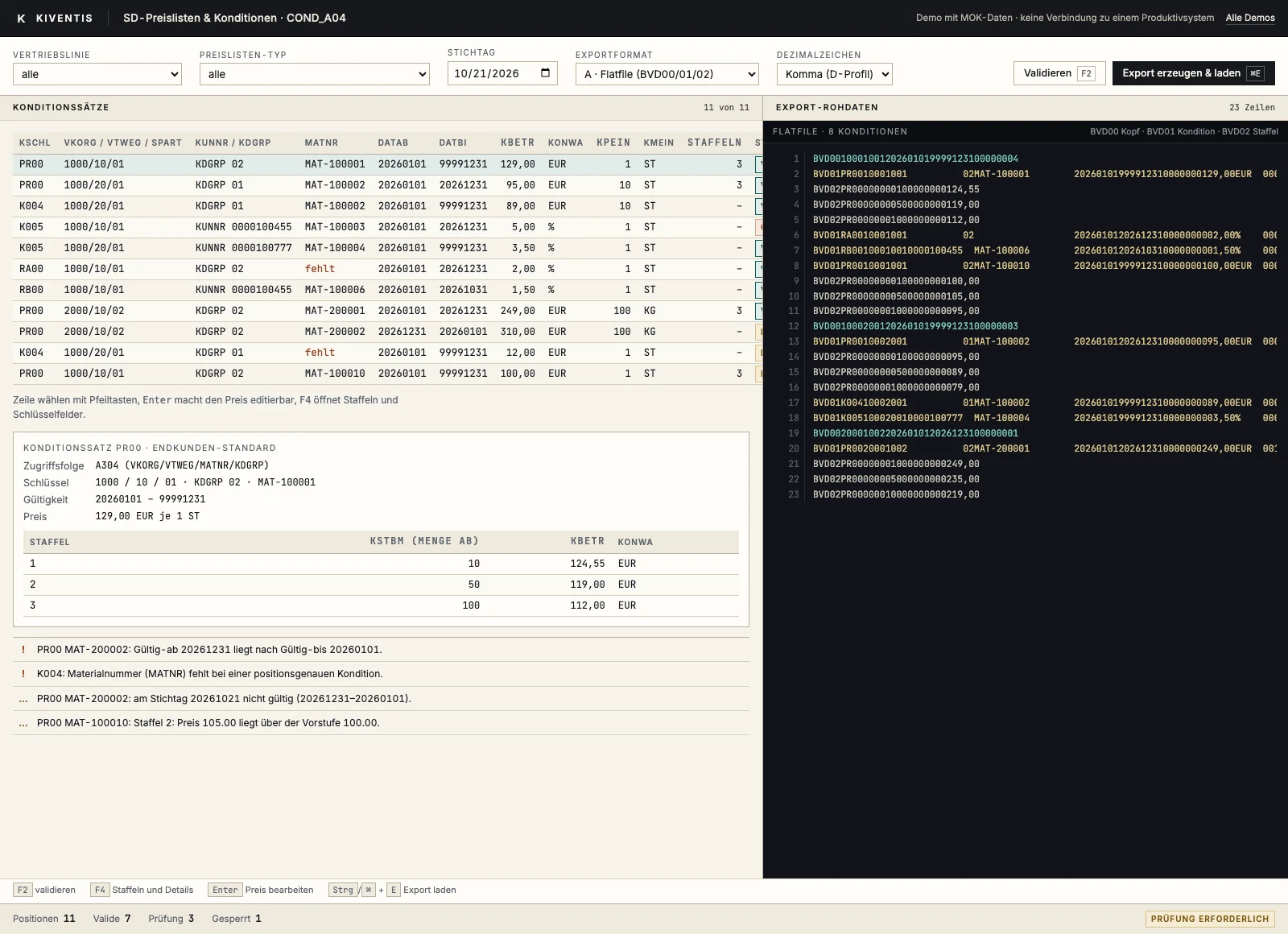
Eleven condition records with scale prices, validity periods and discounts, written in the structure the condition import expects. Invalid dates and illogical scales surface before export rather than later at the customer.
Open live demo →Two anonymised references with before-and-after figures. We name clients on request; some projects are contractually bound to anonymity.
Special-purpose machinery · 240 employees · Baden-Württemberg
Preparing quotations for highly complex machined parts meant searching more than 80 pages of CAD specification per enquiry. Quotes took three to five working days, and orders went to faster competitors.
Solution: a three-week online course for technical sales. The team built its own search mask from prompts that matches CAD notes against ERP costings.
“Our sales engineers were sceptical about AI at first. After the training they had built their own tool. We now win tenders because we deliver a precise quote the same day.”
| Metric | before | after | change |
|---|---|---|---|
| Review time per enquiry | 45 min | 6 min | −87% |
| Time to quote | 4 days | 4 hours | 24× faster |
| Quote conversion rate | 22% | 38% | +72% |
Technical wholesale · 140 employees · Vienna and Singapore
More than 1,200 supplier claims and freight discrepancies per month were copied by hand into SAP and Excel. Handling time exceeded 15 minutes per case, with a noticeable error rate in credit notes.
Solution: training for the customer service team, followed by a claims assistant that reads emails, reconciles them in the ERP and proposes posting drafts.
“The KIVENTIS team does not talk consultant jargon – they show staff at the screen how to solve the task. Our service agents love the new tool, and we save hundreds of working hours every month.”
| Metric | before | after | change |
|---|---|---|---|
| Handling time per case | 15 min | 2.8 min | −81% |
| Automation level | 0% | 81% | largely automated |
| Error rate in credit notes | 8.4% | 0.3% | −96% |
All programs run online, one to two sessions per week. No travel costs, no billing by the hour.
| Program | Price | Duration and participants | Included |
|---|---|---|---|
| Opportunity Scan Entry point and baseline |
€999introductory price, list €2,400 | 2 weeks up to 8 executives |
|
| AI and Vibe Coding intensive course Our most booked format |
€4,900flat fee for the whole department | 4 weeks up to 12 specialists |
|
| Enterprise AI enablement and compliance For companies with 50+ employees |
€9,250full program | 12 weeks up to 50 employees |
|
All prices exclude VAT. The introductory price for the Opportunity Scan is time-limited; the end date is stated in the offer.
This is the timeline for the intensive course. The enterprise program spreads the same steps over twelve weeks.
Map processes, record tools in use, clarify data flows, review data processing agreements.
Fix three interventions, define the success metric and how it is measured, agree participants.
Article 4 training, then building the first internal tool with real company data.
Move the tool into operation, file the documentation, measure and record the result.
Specialists in purchasing, sales or work preparation describe in plain language what the tool should do. The model writes the code, and the specialist checks the result against real data. Typical outputs are BOM calculators, e-invoice (ZUGFeRD) validators or reorder portals. Anyone who has configured an ERP form before will be comfortable with it.
Through a three-stage staging layer with schema validation and OData or REST interfaces. Tools only read; there are no write operations on production tables. That is the first question we settle with your IT, not the last.
Article 4 requires an appropriate level of AI literacy in the workforce, depending on prior knowledge, role and use case. A certificate on its own does not satisfy that. It becomes verifiable through role-specific training content, a usage policy and a register of the systems in use.
Yes. Open-weight models such as Qwen, DeepSeek, Mistral or Gemma run through vLLM or Ollama on your own hardware, with the knowledge base in a local vector store such as Qdrant or pgvector. Traffic stays inside the corporate network; a 14 to 32 billion parameter model generally fits on a single GPU.
In our projects, payback typically lands at two to four months, calculated with 4.5 to 7 hours saved per week and specialist at €75 per hour. That is an observed figure, not a guarantee: the Opportunity Scan recalculates it with your process times and your hourly rate before you commit.
In the first call we walk through one process you already know – and tell you whether a project makes sense. If it does not, we say so.
The mid-market practice guide runs to 38 pages and is free of charge.